


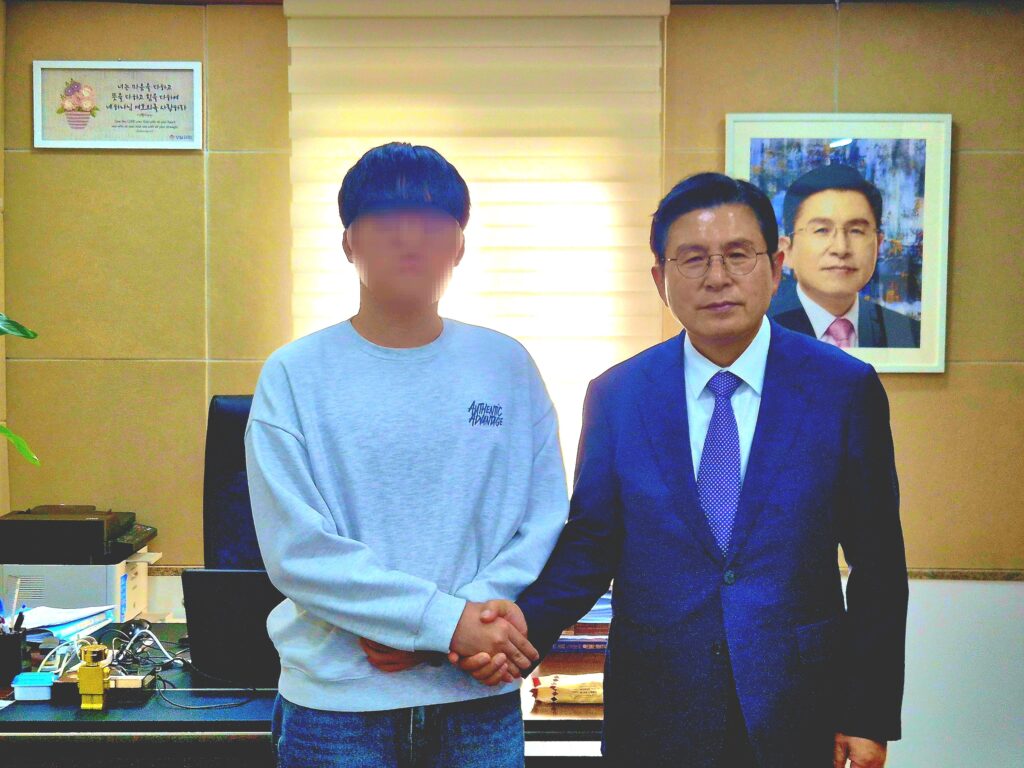
- 1[Chungraon = Executive Director Changmin Ahn, Cheongeum = Executive Director Abraham Kyuhyun Ban, YouthPeak = Executive Director Yoonbeen Baik, YouthFocus = Executive Director Jaewon Choi, Saebit = Representative Director Seongman Jo] Kyo-ahn Hwang, the leader of Freedom & Innovation, urged teenagers and young adults to hold on to their dreams and keep taking on new challenges.
- 2Hwang served as South Korea’s 44th prime minister and as acting president.
- 3Hwang began his career in public service as a prosecutor and went on to serve as minister of justice, prime minister, and acting president.
[Chungraon = Executive Director Changmin Ahn, Cheongeum = Executive Director Abraham Kyuhyun Ban, YouthPeak = Executive Director Yoonbeen Baik, YouthFocus = Executive Director Jaewon Choi, Saebit = Representative Director Seongman Jo] Kyo-ahn Hwang, the leader of Freedom & Innovation, urged teenagers and young adults to hold on to their dreams and keep taking on new challenges. Hwang served as South Korea’s 44th prime minister and as acting president.
Hwang began his career in public service as a prosecutor and went on to serve as minister of justice, prime minister, and acting president. He later entered politics, led the Liberty Korea Party, and now heads Freedom & Innovation.
Hwang described teenagers and young adults as a generation that will shape South Korea’s future. He said older generations should give young people opportunities to put their talents to use. On juvenile crime, he called for a balance between punishment and rehabilitation. On political participation, he stressed the importance of a solid education and the ability to make up one’s own mind.
Youth media organization Chungraon led the in-person interview alongside Cheongeum, YouthFocus, and YouthPeak, its fellow members of the Korea Youth Press Federation. Saebit, which has a memorandum of understanding with Chungraon, supported the interview. The conversation covered what drew Hwang to public service, policies affecting teenagers and young adults, proposals to change the minimum age of criminal responsibility, young people’s political rights and civic education, and what it means to give everyone a fair chance. Hwang also shared advice for teenagers.
Q. Hello. To start, could you tell readers of Chungraon and the Korea Youth Press Federation a little about yourself?
A. I’m Kyo-ahn Hwang. I spent my career as a prosecutor before serving as minister of justice, prime minister, and acting president. I entered politics because I felt I couldn’t stand by as I watched the country fall apart. Forty-five days after I entered politics, I became leader of what was then the Liberty Korea Party. Since then, I’ve done everything I can to protect the Republic of Korea.
Q. You began your public service career as a prosecutor and went on to serve as minister of justice, prime minister, and acting president. What did you dream of doing as a teenager, and what led you to a career in law and public service?
A. In middle school, I was a kid who loved literature. I won quite a few prizes for things I wrote and submitted. In high school, I was a bit of a romantic. I sang and played music. Have you ever heard of the musical saw? You bend a saw and play it like an instrument. That’s what I played. I performed at charity concerts and events like that, and I was once invited to perform on air. I did all of that alongside my studies.
When it was time to go to university, I decided to go into law. I passed the exam and became a prosecutor. I was assigned to the public security division and worked there for a long time, though it hadn’t been my plan to specialize in public security. Looking back, I loved literature and music when I was young. As an adult, I think I wanted to work in public service and help people. Becoming a prosecutor was how I did that.
Q. You enforced the law as a prosecutor and minister of justice, then took responsibility for running the country as prime minister and acting president. Did seeing South Korea from these different positions change your views on the issues teenagers and young adults face?
A. My views have stayed the same from the start. I care deeply about both teenagers and young adults. I spent many years mentoring young people through my church. In your teens, you can find yourself feeling lost for all sorts of reasons, even ones beyond your control. That’s why I think you need a mentor. A friend can be a mentor, too. What matters is having someone you can talk things through with when you’re having a hard time.
I often tell young adults that South Korea has never had so many talented young people. I feel the same way about our teenagers. Even very talented people need to find a path of their own. They should be able to do work they care about, contribute to society, and bring happiness to others. The economy is tough right now, and there are plenty of other problems. Even so, you have to hold on to your dreams. You need a dream to build a future. I believe that holding on to yours can help you get through hard times.
Q. Policymakers have recently been discussing whether to restrict or regulate teenagers’ use of social media. What do you think of those proposals?
A. I believe we should start by giving teenagers freedom. South Korea is a liberal democracy. We should keep restrictions and enforcement to a minimum. Education is essential. Young people need to learn what’s appropriate and what to avoid so they can make their own decisions. It’s a problem if we start punishing them for mistakes before anyone has properly taught them how to handle these situations.
Give them freedom first and teach them how to make sound decisions. If problems still come up, we can take additional steps or set limits where they’re needed. I think we can avoid sweeping restrictions from the outset.
Q. As prime minister, you visited the Rainbow Youth Center (Migrant Youth Foundation) and met young North Korean defectors and young people from multicultural backgrounds. What stands out from that visit? What changes in policy or public services would help young people from different backgrounds feel included in society?
A. What struck me was how hard it was for them just to adjust to a new environment. They were so focused on getting through each day that they seemed to have little time to think about what they wanted to do or what they dreamed of becoming. I felt it was important to help them see a future for themselves.
You know the saying about giving someone a fish and teaching them to fish? I think there’s truth in it. A fish feeds someone for the moment. What happens when it’s gone? They have to rely on someone to give them another. Learning to fish takes a little more time, but it gives them a way to get by on their own.
I grew up very poor myself. My parents fled from North Korea, and I was born into a refugee family. Times were hard across the country then. Imagine how much harder it was for refugee families. I grew up in those circumstances and went on to become minister of justice and prime minister. That’s what I tell young adults. In South Korea, people born into difficult circumstances can find opportunities, too. We should help young people meet their immediate needs and give them the skills to live independently. That’s what I think matters.
Q. Some people have called for tougher penalties for teenagers who commit serious crimes. Others want greater emphasis on prevention and rehabilitation. What is your position on changing the minimum age of criminal responsibility, preventing juvenile crime, and helping young offenders return to society?
A. I support lowering the minimum age of criminal responsibility from 14 to 12. Young people today are physically bigger than they used to be, and they learn and absorb information more quickly. Some commit crimes as serious as those committed by adults, so I think we need to take those changes into account.
I give more weight to rehabilitation than to punishment. With a young person who has committed a crime, the priority should be helping them change. Prisons should help people change their behavior as part of their sentence. That’s especially important for young people.
Deciding how to punish a crime matters, and we also need ways to prevent young people from getting involved in crime in the first place. One option is to give young people someone they can turn to for help. I think that would do more good than assigning more people to monitor them. We could give university students or other young adults that role and support them in doing the work.
Of course, victims need strong protection. We have to make sure they receive it. At the same time, young offenders should have a path back into society through rehabilitation. We have a duty to protect victims and give young offenders a chance to change. We have a responsibility to both.
Q. Lowering the voting age to 18 has given more young people the chance to take part in politics. How do you think this change will affect South Korean democracy? How should schools teach students about politics and civic life?
A. I’m in favor of lowering the voting age. Whether it’s 18 or 16, I think it’s good to give teenagers more opportunities. Teenagers today have social media, AI, and all kinds of ways to get information. They know more about society than they used to. I think young people who are ready to make informed decisions should have the chance to take part in society a little earlier.
Education about politics is essential. Telling students to vote as soon as they’re old enough is only a start. They need to learn what politics is and how democracy works. We can make those lessons engaging. I’d like to see programs that students enjoy and can understand.
I also think the curriculum needs to be carefully reviewed. Students are still learning, so what they’re taught and how it’s presented matter a great deal. There was a major controversy over history textbooks some years ago. At the time, I thought there were areas of bias in history education, and I looked for ways to address them. That was part of the thinking behind the push for government-issued textbooks. The process revealed several problems and shortcomings, and the initiative ultimately failed. I think we need to give a range of people enough time to work together, review the material, and produce a good textbook. Then we can let schools choose it on the same terms as any other textbook.
I see politics the same way. Politics can serve a good purpose, and problems arise when people misuse it. Young people should learn about politics, too. What matters is that they learn from carefully vetted materials and can reach their own conclusions.
Q. Many teenagers and young adults say hard work alone can’t change their future when they face competition for university places and jobs, housing difficulties, and a gap in opportunities between the Seoul metropolitan area and the rest of the country. What does genuine fairness mean to you? What should political leaders change first so that young people can pursue their dreams regardless of their background?
A. I make a distinction between treating everyone alike and giving everyone an equal opportunity. Fairness is about equal opportunity. A minister’s son shouldn’t be treated like a minister. A professor’s child shouldn’t receive special treatment, either. That applies to university admissions and hiring alike.
Academic ability is just one kind of talent. Someone who struggles in school may be a gifted singer or athlete. We should open up paths for those people to put their talents to use. We can give people different ways to show what they can do.
Older generations have to change first. If established politicians hold on to every position for themselves, how are young adults supposed to get in? They’re bound to have less experience. How will they ever get any unless someone gives them a chance? In our party, we’re working to give young adults real responsibilities. Three of the 11 chairs of our metropolitan and provincial branches are young adults, and our secretary-general is 34. They’re in charge of running their organizations and doing the work. It may take them a while to get the hang of things. The older generation can help them with that. From what I’ve seen, they’re doing well. What matters is giving them a chance.
A person’s background should never shut them out before they’ve had a chance. Nobody should be able to use their parents’ connections to get ahead. People should be recognized for their own abilities and effort, regardless of who their parents are. That’s what a fair society looks like to me.
Q. Many teenagers dream of careers in politics, law, journalism, or other areas of public life but hesitate because they fear failure or criticism. Drawing on your years in public service and politics, what advice would you give them? Is there anything else you’d like to say to readers of Chungraon and the Korea Youth Press Federation?
A. I’d like to say that failure is a credential, too. When we hear the word ‘credentials,’ we usually think of getting into a good university or landing a good job. I think failure can count just as much. Say you apply for a job and get turned down. You try again, and you might get turned down again. Each time, though, you learn something. You see where you went wrong and what you could do differently next time. If you keep at it, your chances of succeeding get better. You can keep going after a failure and use what you learned the next time you try.
Listening matters, too. We put a lot of effort into speaking, and we ought to put just as much effort into listening. Some people cut in while someone else is talking so they can get their own point in first. I think we should let people finish before we say what we think. Hold on to your convictions, and make time to hear others out. I have a few more things to say to readers of Chungraon and the Korea Youth Press Federation.
First, one year in your teens is worth ten later in life. I think a year in your teens is different from a year in your thirties, forties, or fifties. The time you have now is precious. Value it and use it well.
Second, take the initiative. Students often do what their teachers or parents ask them to do. Of course, that’s important, too. I want you to look for something that needs doing and try it before anyone asks. You can do that even in your first year of high school. If you see something worthwhile that you can do, or something that needs to be done, go ahead and start.
Finally, aim to get just half a step ahead. If you try to get two full steps ahead right away, you’ll pull a muscle. Pace yourself. The important thing is to keep moving, even if you only get a little ahead at a time. I believe that if you keep at it long enough, you can eventually become a leader.
Q. One more question, on a personal note. When you were prime minister, did you ever get nervous going on air or appearing at official events? How did you handle those nerves?
A. I think drawing on your faith can help. Whether you practice Buddhism, Christianity, or another faith, it can help you steady yourself when you’re nervous.
The second thing is preparation. The more you prepare, the better you do. If you put in less preparation, it shows. Even when you think you’ve prepared enough, go through it once more. If you have ten minutes left, use those ten minutes to prepare a little more. Preparation is the answer. Preparation is the answer.
In the interview, Kyo-ahn Hwang, the former prime minister who now leads Freedom & Innovation, urged teenagers and young adults to believe in what they can do and take an active role in shaping their future.
He encouraged young people to treat failure as an experience they can grow from. He also stressed the importance of listening, taking the initiative, and keeping at what they set out to do.
Hwang outlined his views on a range of issues, including the minimum age of criminal responsibility, expanding young people’s political rights, civic education, and ensuring equal opportunity.
We hope this interview gives teenagers and young adults a chance to reflect on their dreams and their future, and to think about what it means to take part in politics and society. Chungraon and the Korea Youth Press Federation will continue to cover social issues from a youth perspective and share what people of different generations and views have to say.
Korean version of this article: https://cheongeumnews.kr/article/93
/Executive Director Changmin Ahn, Executive Director Abraham Kyuhyun Ban(Cheongeum), Executive Director Yoonbeen Baik(YouthPeak), Executive Director Jaewon Choi(YouthFocus), Representative Director Seongman Jo(Saebit)


